
 The Educator Preparation Provider (EPP) at Drury University, which is made up of the School of Education and Child Development (SECD) faculty, staff, and administrators, and all other full and part-time faculty contributing to the preparation of teachers, has been approved by Missouri’s Department of Elementary and Secondary Education.
All programs leading to teacher certification at the initial and advanced levels have been approved by the Missouri Department of Elementary and Secondary Education (DESE).
We are working on securing a data-sharing Memorandum of Understanding with local school districts that employ several Drury University SECD completers to provide us with data regarding their impact on P-12 learning and development. Of the districts we reached out to, the Lebanon School District was the only one to provide us with data specific to our completers. The data is linked below. The Drury SECD is continuing to reach out to school districts to obtain further data regarding our completers.
Lebanon School District – Drury Completers MAP Data
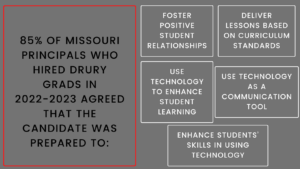 The First-Year Teacher Survey, collected by Missouri’s Department of Elementary and Secondary Education (DESE) and The University of Missouri’s Office of Social and Economic Data Analysis (OSEDA), is completed by the teacher’s principal reflecting their impression of the overall quality of the educator preparation program their teacher completed. The link below shows the average ratings of Drury completers and other Missouri completers from 2017 to 2021.
The following set of data reflects employer satisfaction with the Drury University School of Education and Child Development graduates based on their ability to meet the nine Missouri Teaching Standards.
The data above comes from the DESE First-Year Teacher Survey, assessed by the principals of Drury first-year teachers. On November 30th, 2022, the Drury SECD sent out a survey to collect data regarding our completer’s placement and milestones. The survey was sent to completers from 2020 through 2022 who had no contact restrictions. Of the 109 eligible to receive the survey, 16 responded, resulting in a 15% response rate. This data was combined with data from the initial survey, sent in 2019, which was sent to completers from 2017 through 2019 who had no contact restrictions. Of the 160 eligible to receive the survey, 45 responded, resulting in a response rate of 28%. This survey will be administered annually to completers without contact restrictions and data reported accordingly.
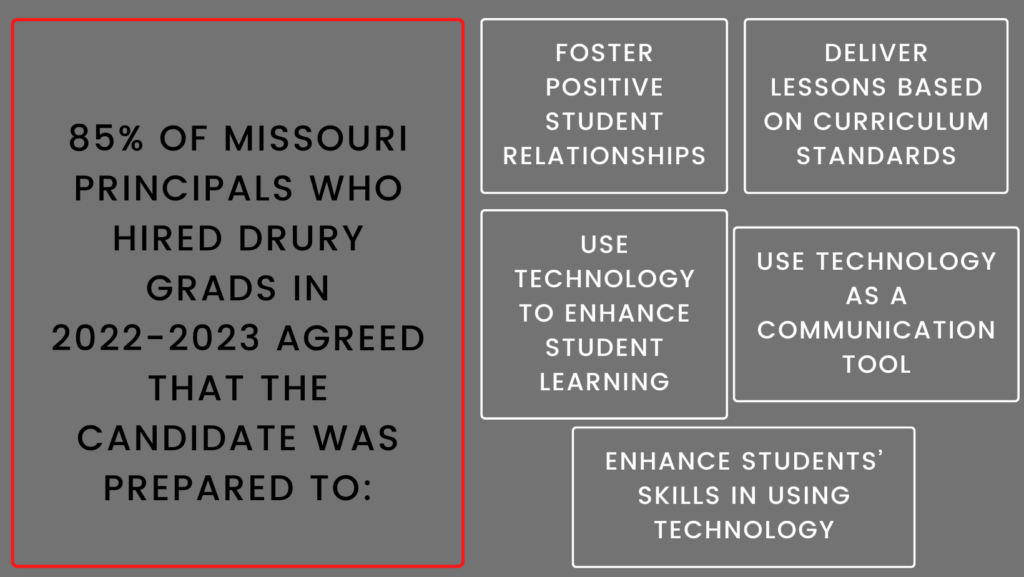
DESE in collaboration with the University of Missouri’s Office of Social and Economic Data Analysis (OSEDA), has administered an annual survey of first-year teachers in Missouri public schools. A companion survey of employers of first-year teachers – typically their principals – has been administered. Together, the two surveys form a statewide data collection effort known widely as the First-Year Teacher Survey. The document below displays the responses of first-year, Drury teachers over the past three years.
First-Year Teacher Surveys 2017-23 – Teacher Responses
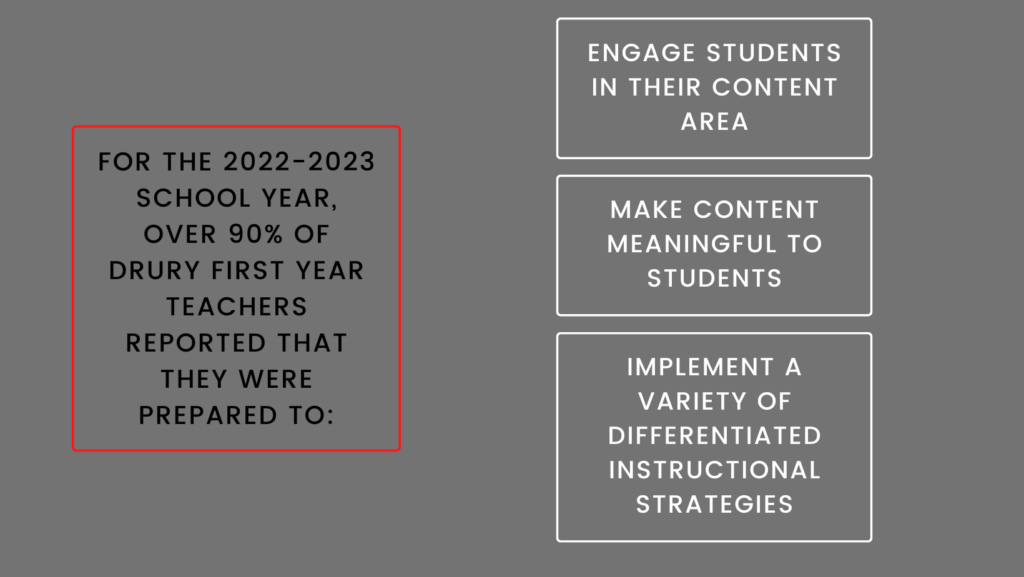
The following data was collected by the Drury University School of Education and Child Development, spanning from 2017 through 2021.
Missouri Annual Performance Report
The Missouri Annual Performance Report for Educator Preparation Programs (APR-EPPs) is based on five-years of reporting by educator preparation programs at Missouri colleges and universities. The APR-EPP is completed by the Missouri Department of Elementary and Secondary Education (DESE) each year and will consist of performance data measured to determine whether an individual certification program continues to meet state standards. The report is based upon the Missouri Standards for the Preparation of Educators (MoSPE) Standard 1 Academics, Standard 3 Field and Clinical Experiences, and Standard 4 Candidates. The overall goal of MoSPE and the APR-EPP is to ensure that together we are preparing, developing and supporting educators. The individual APR-EPP and the 2018 Comprehensive Guide to the Annual Performance Report for Educator Preparation Programs are available online.
*Publicly-accessible APR Report for 2020 was suspended due to COVID-19.
*Publicly-accessible APR Report for 2023 is currently under development by DESE. Data for the measure are expected to become available to the public by August 2024.
Title II: Higher Education Act Sections 205 through 208 of Title II of the Higher Education Act (HEA) calls for the accountability for programs that prepare teachers. Educator preparation programs (EPPs) report to the state then report to the U.S. Department of Education. EPPs report annually on:
Assessment Plan – School of Education and Child Development
Beginning September 2014, candidates seeking educator certification in Missouri are required to achieve a passing score on the appropriate Missouri Content Assessments (MoCA). Effective August 31, 2014, the Praxis II series was no longer used for Missouri educator certification candidates. The MoCA is a measure of teacher candidates’ content knowledge specific to the area in which each is seeking certification. The assessments are aligned with state and national standards and may include several subtests.
Each year, the Missouri Department of Elementary and Secondary Education provides information on district employees employed in Missouri public schools to the teacher education program in which they were prepared. This data allows Drury SECD to track completers’ persistence in the profession in Missouri public schools. Drury also uses completer exit surveys as well as alumni surveys to provide the SECD with updated information.
Drury Completer Placement Data 2017-2021
*Data for the ability of completers to be hired in Education Positions for Which They Have Prepared in currently under development by DESE. Data for the measure are expected to become available to the public by November 2024.