
Not many students have had a better first year at a new university than Zachary Stockton did in his first year at Drury in 2024-25. Zach, who transferred to Drury from the University of Kansas after a gap year spent living and working in Chicago, is an English and Writing major and both a campus and community activist. In April, Zach earned a Critical Language Scholarship from the U.S. State Department which allowed him to spend eight weeks studying in Tanzania. Later that same month he was named as a Truman Scholarship recipient, becoming the first student in Drury history to be so honored. He is the first student at a southwest Missouri college or university to be named a Truman Scholar since 1999, and was one of just three students from Missouri to earn the honor in 2025.
Drury Today sat down with Zach recently to discuss his whirlwind first year on campus, his extraordinary summer experience in East Africa, and what’s next for the Topeka, Kan., native.
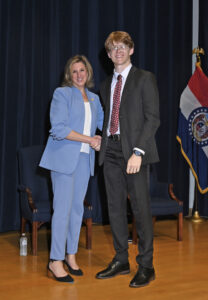
Drury Today: You started your academic journey at the University of Kansas and eventually made your way to Drury. Take us through that journey.
Zachary Stockton: I did two years at KU, which is 30 minutes from my hometown. It made sense for me at the time but I really wasn’t sure what I wanted to do professionally. I changed my major every two weeks. After my sophomore year, I took a gap year and moved to Chicago. I didn’t think I’d ever go back to college. I lived there for a year and had the opportunity to work at The Art Institute of Chicago, which was amazing. After a year, I thought I was ready to go back to college and focus on writing. My girlfriend was attending Drury and I had been to campus several times and even sat in on some classes, and that kind of introduced me to how welcoming the University is, and I got a taste of the culture of Springfield as well. Coincidentally, tuition here for me was cheaper than an apartment in Chicago, so I decided to go back to school.
DT: Walk me through the process of applying for and winning a Truman Scholarship. How did it all begin?
ZS: It’s a long process. I met with Dr. Shelley Wolbrink early in the fall semester and I don’t recall what drew me to her office on that day. I was in there all the time talking to different counselors, checking out the scholarships and getting clarity on my schedule. Dr. Wolbrink first began speaking to me about the Critical Language Scholarship, and I was interested. I applied and we were both really happy with my application, and during our first CLS meeting she began talking to me about the Truman Scholarship. She told me it was a time-consuming application process. I thought about it and decided to apply. I spent most of the end of the fall semester working on the application. I worked extensively on it during winter break. It worked out pretty well.
DT: You’re the first Drury student to win a Truman. As you think about it, what does that mean to you?
ZS: I think there’s a level of responsibility I hold now. I have this opportunity that a lot of students haven’t had in the past. I feel so blessed to be where I’m at now, and I also feel very grateful. I only received this scholarship because of the faculty here. I know Drury will have another Truman Scholar because the faculty and administrators here were so supportive of my journey. They were meeting with me almost daily. They’ve opened every door I needed open.
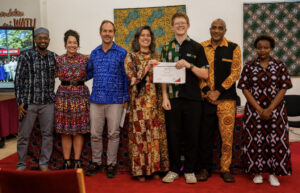
DT: Tell us about your overall experience to this point with the Truman Scholarship program.
ZS: I went to the Truman leadership week at the Truman Library in Independence. People were flying in from all over the country. I just had to drive two and a half hours. I felt like I was welcoming everyone to Missouri. I was selected during the week to give a speech at the welcome dinner. It was surreal, because I’m here in Missouri, a state I never imagined I’d end up in. I haven’t left the Midwest. I’ve been able to see different corners of this region, and then to able to welcome people from across the country into my little pocket was incredibly rewarding, and it really felt like that was the most complete moment I’ve had to this point in my life.
DT: The $30,000 postgraduate scholarship is a key component of being named a Truman Scholar. What are your plans?
ZS: A year ago I never saw myself returning to college, let alone attend grad school. It’s mind-blowing. I want to attend a grad school with programs that focus on social justice. I know that what I want to do is help people directly in the community. I want to do direct service and focus on urban inequity, such as responding to red-lining in housing in large urban centers. But it could also be working in a school working for violence prevention programs.
DT: Right before you were announced as a Truman Scholar, you received a Critical Language Scholarship from the U.S. State Department. As a part of that CLS scholarship, you spent eight weeks in Tanzania this past summer, living with a host family. Tell me about them. What was the overall experience like? Were you fully immersed in their culture? Were there language barriers?
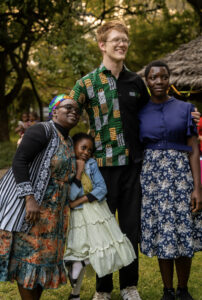
ZS: It was life-changing. My host family was the best part of the entire program. There are so many things about the CLS program that are rewarding. I made pretty sizeable language gains. I went in knowing nothing and at the end of the program I did a 10-minute project on housing policy in Swahili. I was able to express my thoughts on larger topics, in Swahili. Coming back to the states was weird because I couldn’t remember how to say numbers in English. That was a big joke we made while we were there, ‘Are we going to remember English?’ I was in a cohort program with 25 other students from various colleges across America and we were all able to experience that together, and that helped a lot. The most rewarding part was living with my host family. I had a little sister and we’d walk to the market to get ice cream. I’d watch television with my host family every night. We went to a local sports bar to watch a soccer game. It was so immersive to live with a family in that way. I know coming back to the states that’s the relationship I care most about keeping. These weren’t just people I lived with for eight weeks. These people are my family. I can’t wait to go back to them.
DT: Why Tanzania? Were you assigned there?
ZS: When I spoke with Dr. Wolbrink and she specifically recommended Tanzania. During the application process, I found out that there was a sizeable Tanzanian population with quite a few Swahili speakers in Chicago. So, I thought that was something that could directly help me communicate with those people.
I never thought I would go abroad, but I knew if I did, I wanted to go somewhere that wasn’t Westernized. I wanted it to be something that was so culturally different than America that I came back with a new sense of what it means to be American, and what it means to be human.
DT: You have only been here a year. Clearly, you’ve made an impact on Drury and Springfield in your short time on campus. What of impact have Drury and Springfield had on you?
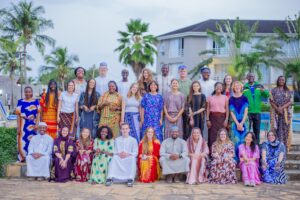
ZS: They’ve had more if an impact on me than I’ve had on them. I come to school each day with a sense of pride to be at Drury University. This is another family for me. This is my community. I have faculty who are my mentors. I have people who are students that have supported me every step of the way. I’ve made more progress interpersonally in two semesters at Drury than I would have made in four years at other institutions.
DT: You’re really engaged on campus and in the community. Where does that come from?
ZS: My hometown is a capital city, and not terribly different from Springfield. A lot of the same issues on the north side of Springfield faces with economic disinvestment in terms of infrastructure, are similar to the issues I’ve witnessed in my neighborhood in Central Park Topeka. I began to pick up on all of this as a young child. My elementary school is right across the street from the school that inspired the Brown v. Board of Education case. Economic inequality and racial inequality were ingrained in us at a young age, and it made me interested in community service but also responding to inequality. In Chicago, I was able to see urbanization on a different scale. Coming to Springfield, I was able to apply some of that knowledge. That’s been where that passion derives from. I’ve experienced it first hand, and I understand that I have a role to open that door whenever I can.
DT: It sounds like you come from a community-minded family.
ZS: My family has an open-door policy for the community. We always have room on the couch. My whole life, people in the community who didn’t have a safe space could come to my home. My family is the reason I have this heart. My family values service, but they also value saying ‘we can serve, so why wouldn’t we?’
DT: After one of the best years by a student in Drury history, what do you do for an encore?
ZS: I think this year I’m focusing on grad school and opportunities which can help propel me towards a future where I can help more people and expand my impact.