
Chip Parker is as much a part of the fabric at Drury University as Late Night Breakfast and the civil war cannons in front of Burnham Hall. Chip first arrived at Drury as a freshman in the fall of 1979… and never left. Forty-seven years later his impact on Drury – and Drury’s impact on him – extends far and wide. From his start as an admissions counselor, to Director of Admissions, to his current role as Associate Dean of Students for Student Success, Parker is Drury through and through. His mother, wife, three children and two siblings all count themselves as Drury alums.
Drury Today recently sat down with “Mr. Drury” to talk about his journey, what he’s experienced, and what’s next.
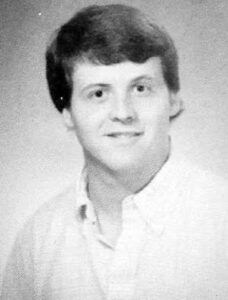
Drury Today: Tell me about your background, where you grew up, and how you ended up as a Drury undergrad?
Chip Parker: I was born and raised in New Orleans. My mother attended Drury for two years, at the same time as Bob Barker. My grandparents lived in Springfield and when I was a kid, we spent our summers here. We made lots of visits to Springfield. As I’m about to graduate from high school, I didn’t know what I was doing for college. My father went to Tulane. I was thinking about LSU; I had a lot of friends going there. My parents stepped in and said I needed a smaller school. They said if I would try Drury for one semester, that if I didn’t like it, I could go anywhere I wanted to go. I came up here, moved into Turner Hall and the rest is history. Almost 47 years later, here I am still at Drury.
DT: How different is Drury now compared to when you arrived?
CP: Physically, it’s twice as large. The saying used to be ’40 acres of Christian atmosphere’ and now we’re almost 100 acres. The academics have remained strong. But one way we’ve changed is that we don’t seem to be as close-knit a community as we were back then. I think we’re a bit more siloed and fragmented now, but that likely has to do with the growth of the student body, faculty and staff. Is that good or bad? I don’t know. It’s just reality.
DT: Once you arrived on campus as a freshman did you have any idea that 47 years later, you’d still be here?
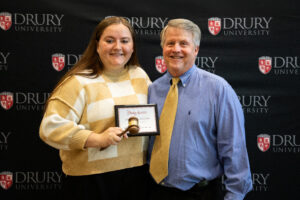
CP: None whatsoever. I had no idea. I was certain I would go off and do something else, but I had no idea what. My senior year, close to graduation, we had a senior celebration dinner at Fantastic Caverns. I was in the buffet line and someone came up to me and asked what I was doing after graduation. I had no idea. I was a double major in Criminology and Communications/PR. They tried to get me to join the police academy, but I didn’t want to do that. I thought about the FBI but that failed to materialize. Someone told me there were two openings in the admissions office, and the next Monday I touched base with the director, applied, interviewed and went home. I heard nothing for a month. They finally contacted me and offered me the job of Admissions Counselor. My first day was June 8, 1983.
DT: At what point did you see a long-term path to a career at Drury.
CP: I went into my stint as an Admissions Counselor with the idea that this was a six-month-to-a-year type of opportunity. I truly envisioned that was about it. I think the more I became invested in the institution, the more I found myself connecting with students and making a difference. That started to excite me, knowing that I was helping create future dreams for students. The more I did it, the years just seemed to pass. I started out as admissions counselor and began climbing the ladder. Drury gave me the opportunity to be somewhat mobile within the university and that really helped.
DT: In the early years, did you ever seriously consider taking a job outside of Drury?
CP: Oh, sure. Opportunities were out there, especially in the admissions world. I would look and apply, and I explored some things. But ultimately, I liked what I had here. Being here made a difference to me.

DT: Can you name all the positions you’ve had at Drury? Any favorites?
CP: I worked in various roles in Admissions for 27 years. For 17 of those years, I had a territory, which was primarily southeast Missouri. I also had Little Rock and Denver. Then I transitioned into becoming the Transfer Coordinator, concentrating on recruiting transfer students. I ended up being the Director of Admissions and ran the office for eight years. I worked with a great team. We had a lot of staff continuity. I believed in that. It was important to me. I then transitioned out of admissions and into Student Affairs because I had three kids and they were growing fast, and I didn’t want to miss anything with them. I became the Director of Retention, the first one ever at Drury. So, I joined Student Affairs in 2010. I had a small sabbatical from that, going over to Advancement for about six months after John Beuerlein convinced me to make the move. But I missed the students. They never filled my position in Student Affairs, so I transitioned back a few years ago. I have had a lot of side gigs in athletics, like working the basketball scorer’s table for 42 years. I started out as the official scorebook keeper and then moved over to running the shot clock.
DT: What is it that you love so much about working with the students?
CP: I truly believe that I’m making a difference. I had a wonderful experience as a student at Drury. I loved it. I would like to believe that if I can help transfer that to them just a little bit, that they’re going to enjoy this experience. I want them to feel what I felt. I have mixed feelings sometimes, because I spend a lot of time dealing with at-risk students. I want them to feel like they can come to me. I’m not Dr. Parker or Dean Parker. I’m Chip.
DT: We live in a time where people don’t stay at one place for very long. What is it about Drury that’s kept you here for close to 50 years?
CP: The people. It’s the people. I have always enjoyed my colleagues. I believe in Drury. The students, too. They make it fun.
DT: What are some of your favorite memories, either as a student or employee?

CP: I’m proud to be a Kappa Alpha. Some of my dearest and best friends today are my fraternity brothers. Being involved with the Student Union Board. When I was president of SUB, I got to introduce the Ozark Mountain Daredevils at a Homecoming concert in Weiser Gym. That was a big moment. As an employee, we did a barn bash in Bay Hall, which used to be Walker Library. When we converted it, the building was gutted and John Moore decided to have a barn dance before we started remodeling. We brought in hay bales, and we had a party for faculty and staff. That was a fun event. We used to have Christmas shows. Different departments were responsible for providing entertainment. I bounced around so much that I was part of the entertainment three times.
DT: There’s an important family aspect to Drury for you as well.
CP: I was very proud of the fact that my kids went here. I was able to hand them their diplomas on graduation day. When they were students, I knew I had to stay away from them. We insisted that they live on campus. They thrived and did good things and were excellent students with good reputations and that made me proud. When I saw them on campus, it was always a warm experience. I can’t forget that my wife also attended Drury as a part of the Drury GO program. My two younger siblings also attended and graduated from Drury. We were all in school at the same time.
DT: Is there life after Drury?
CP: I certainly hope so. My colleagues keep pushing me to get to 50 years. They think it’s a nice round number. For me, it’s one day at a time right now. I’m getting closer to retirement. I want to travel and visit friends and see more of the world. I want to do that more. I’m an avid golfer. I’m not very good but I like to play. And I’d love to not have a schedule.